© 2026 Farm Credit Canada. Used with permission. Additional information is available online at Economics | FCC. For inquiries about this content or to request permission for use, please contact FCC at mediarelations@fcc-fac.ca.
Seeding is only weeks away, but final planting decisions are clouded by a higher degree of uncertainty than usual. Many Canadian crops are expected to face tight margins in 2026, and rising fertilizer prices are adding pressure just as plans are finalized. In our 2026 crop outlook, we noted that crop export pace and cost management would be key to profitability. Since then fertilizer costs have become an even bigger factor amid the turmoil in the Middle East.
While many acres are already committed through crop rotations or contracts, some swing acres remain flexible. Crop rotation usually guides planting decisions, and most years farmers make only small changes. This year, however, may be different. Higher fertilizer prices could shift acres toward lower input crops, reduce fertilizer use, or even take some marginal land out of production. This blog explores where those acreage shifts may occur.
Digging into current seeding projections
Early seeding projections offer a useful snapshot of how farmers are positioning themselves heading into the growing season. Statistics Canada’s 2026 Field Crop Survey suggests Canadian farmers plan to seed more canola, corn, barley, flax, and soybeans, while acres of wheat, oats, lentils, and peas are expected to decline (Table 1).
Table 1: Statistics Canada 2026 preliminary seeding intentions
| Crop | 2025 | 2026 | yr/yr |
|---|---|---|---|
| Barley | 6,135,800 | 6,440,800 | 5.0% |
| Canola | 21,623,100 | 21,839,200 | 1.0% |
| Corn for grain | 3,782,200 | 3,846,200 | 1.7% |
| Corn for silage | 1,043,600 | 957,500 | -8.3% |
| Flax | 620,200 | 753,200 | 21.4% |
| Lentils | 4,379,600 | 4,137,600 | -5.5% |
| Oats | 2,996,100 | 2,903,400 | -3.1% |
| Peas | 3,509,700 | 3,078,300 | -12.3% |
| Soybeans | 5,781,800 | 5,889,500 | 1.9% |
| Durum wheat | 6,531,500 | 6,377,600 | -2.4% |
| Spring wheat | 18,808,900 | 18,781,100 | -0.1% |
| Winter wheat | 1,691,600 | 1,578,800 | -6.7% |
| Principal field crops | 75,212,500 | 75,004,400 |
Sources: Statistics Canada, FCC Economics
It is important to note that this survey was conducted before the outbreak of the U.S. war in Iran. Since then, fertilizer prices have risen, which could influence final planting decisions. To assess the potential impact, we analyzed historical variability in seeded acreage over the past decade. Year-over-year changes for each crop were used as a proxy for the potential range of “swing acres” relative to current Statistics Canada projections (Table 2).
Table 2: Acreage variability and potential swing acres
| Crop | StatCan estimate 2026 | 10-year average variability (+/-) | Swing acres (+/-) |
|---|---|---|---|
| Spring wheat | 18,781,100 | 7.4% | 1,390,000 |
| Canola | 21,839,200 | 3.4% | 740,000 |
| Barley | 6,440,800 | 10.5% | 670,000 |
| Soybeans | 5,889,500 | 10.6% | 620,000 |
| Durum wheat | 6,377,600 | 8.2% | 520,000 |
| Lentils | 4,137,600 | 11.9% | 490,000 |
| Oats | 2,903,400 | 13.4% | 380,000 |
| Peas | 3,078,300 | 11.9% | 360,000 |
| Flax | 753,200 | 21.5% | 160,000 |
| Corn for grain | 3,846,200 | 2.3% | 86,000 |
| Corn for silage | 957,500 | 7.7% | 73,000 |
| Principal field crops | 75,004,400 | 7.3% | 5,489,000 |
Sources: Statistics Canada, FCC Economics
Historically, acreage shifts among major field crops have been limited. We estimate that up to 5.5 million acres—or 7.3% of total principal field crop acres—could still shift from preliminary intentions. Under current market conditions, some of these acres may move toward lower input or more favorable margin crops, including shifts away from high nitrogen crops such as corn toward alternatives like soybeans. Below, we delve into some of the crops to assess the likely direction for those swing acres.
Soybeans versus corn
Statistics Canada is projecting soybean and corn acreage to both increase by nearly 2% from last year; however, these estimates were made before the war began. As a result, corn acreage could ultimately be lower, as producers shift land away from higher-cost crops. Soybeans require less nitrogen fertilizer, making them more competitive in today’s high input-cost environment.
There is room for soybean acreage to move higher, as historical variability exceeds 10%. This appears plausible given current fertilizer prices, particularly in eastern Canada, where producers are more exposed to fertilizer price shocks at planting due to less pre-buying earlier in the season. The soybean-to-corn futures price ratio continues to favour soybeans, reinforcing incentives for additional acreage gains this year, especially in Manitoba and eastern Canada (Figure 1).
Figure 1: Soybean-corn futures price ratio favours planting soybeans
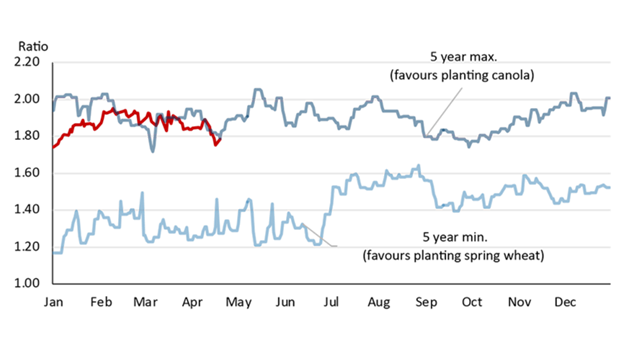
Corn acreage in Canada has historically shown limited flexibility, with swing potential of only about 2.3% because much of the corn crop is tied directly to inelastic local livestock demand. As a result, any expansion in soybean acres is more likely to come at the expense of spring wheat, particularly in Manitoba, where producers have greater flexibility to shift soybean acres from corn and wheat.
Canola versus wheat
Statistics Canada estimates 2026 canola acreage at 21.8 million acres, about 1% higher than 2025. Historically, year-over-year changes in canola acreage have been modest, averaging 3.4%, though even a typical shift can amount to more than 700,000 acres.
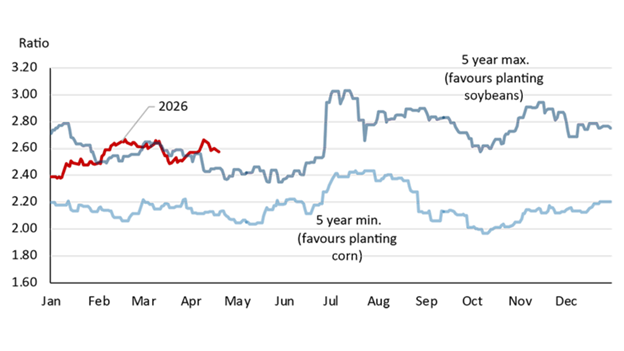
Despite expectations for large ending stocks, several factors continue to support canola plantings. China’s lowering of canola tariffs has improved market access and boosted producer confidence, while expanding domestic crush capacity should help absorb additional supply. Prices have risen, and current price relationships versus spring wheat favour canola (Figure 2).
As seeding decisions are finalized, canola acreage could move above 22 million acres, with a reasonable range of 22 to 22.5 million. Growers also tend to prioritize fertilizer spending on canola over wheat, further supporting acres. While Statistics Canada survey results suggest spring wheat acreage will be largely unchanged in 2026, spring wheat faces the greatest downside risk from acreage shifts into other crops. Canola has additional upside potential, as conflict in Iran is pressuring oil prices higher, improving biofuel economics and potentially incentivizing increased canola acreage.
Figure 2: Canola-spring wheat futures price ratio favours planting canola
Shifts in other crop acres
Shifts in other crops are also possible. While none are major crops on their own, together they represent more than 2.5 million acres of potential swing acres that could still influence overall supply.
Lentil and durum acres are under pressure due to ample supplies and weaker prices. Lentils also face market access risks, including the possibility of higher import tariffs from India. However, both crops require less fertilizer than many alternatives, which may limit acreage declines and keep plantings closer to recent levels. In some regions, durum and lentils are central to crop rotations, making large acreage shifts difficult.
Pea acres are more uncertain. Large ending stocks of peas are a headwind, but they remain worth watching given the removal of tariffs for the Chinese market, high nitrogen prices, and burdensome lentil and durum supplies. Peas are often included in rotations not just for current returns, but for the benefits they provide to profitability in the following year.
Oats and barley remain key wildcards. Oat acres have declined since peaking in 2022 at 3.9 million acres, but history suggests they can still surprise. Over the past decade, oat acreage has varied by about ±440,000 acres, or 13%, year to year. Oats are relatively cheap to grow, which could support acres, but current low prices are a challenge. Barley acres have also trended down longer term, but lower fertilizer needs and a growing cattle herd could support more barley acres in 2026, particularly on marginal land or for silage.
While swing acres among principal field crops often dominate the discussion, other acreage categories—including hay land and unseeded acres—are becoming more relevant as market incentives and profitability pressures shift.
Cattle herd rebuilding: will acres shift back into hay land?
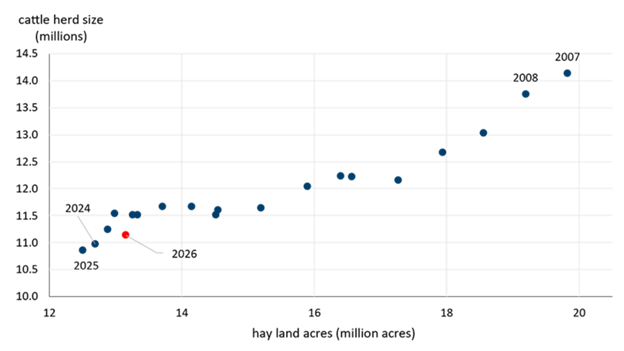
Canada’s cattle herd is finally starting to grow again. As of January 1, 2026, beef replacement heifers were up 4.8% from last year, signaling that producers are making longer-term investments to rebuild their herds. This supports expectations for continued herd growth, and hay land acres could follow that same trend.
Cattle herd expansion points to potential increases in hay land acres. Much of the hay land converted to cropland over the past several decades tended to be marginal land. With cattle prices strong and producers increasingly focused on rebuilding their herds, some of that land could shift back into hay production. If the rebuilding trend continues, past relationships between herd size and hay acres suggest up to 650,000 acres could move into hay, although greater use of corn and barley silage may limit the scale of that shift (Figure 3).
Figure 3: Cattle herd expansion indicates possible acreage shift to hay land
Will unseeded acreage rise this year?
Decisions to leave land unseeded typically depend on factors such as soil moisture, crop prices, and spring weather conditions. With higher fertilizer costs and tighter projected farm margins, unseeded acreage is a key area to watch this year. Historically, unseeded acreage has shown significant variability, sometimes changing by as much as 25%, most often due to crops unable to be planted caused by excessive moisture. Based on that historical range, unseeded acreage could increase by as much as 280,000 acres this year to 1.4 million acres, particularly if producers choose to take marginal land out of production.
Bottom line
Input costs are a major concern amid low crop prices and surging fertilizer prices following the U.S. war in Iran. Overall, we do not expect large swings in seeded acreage, but there is enough flexibility to help farms adjust in a higher fertilizer price environment. If more acres swing into canola and soybeans, wheat is likely to see the largest acreage losses, though smaller adjustments could also come from other crops. Hay land and unseeded acres may also deliver surprises. It will be important to watch how markets move between now and planting, how crop price relationships change over the next month, and how this influences decisions on the remaining acres.

About Farm Credit Canada
Farm Credit Canada builds strong relationships and shares knowledge and expertise with thousands of customers across the country. When they succeed, we succeed. We’re here to support entrepreneurs and believe in the future of agriculture and food. We’re a partner, a catalyst and a champion of our industry.